
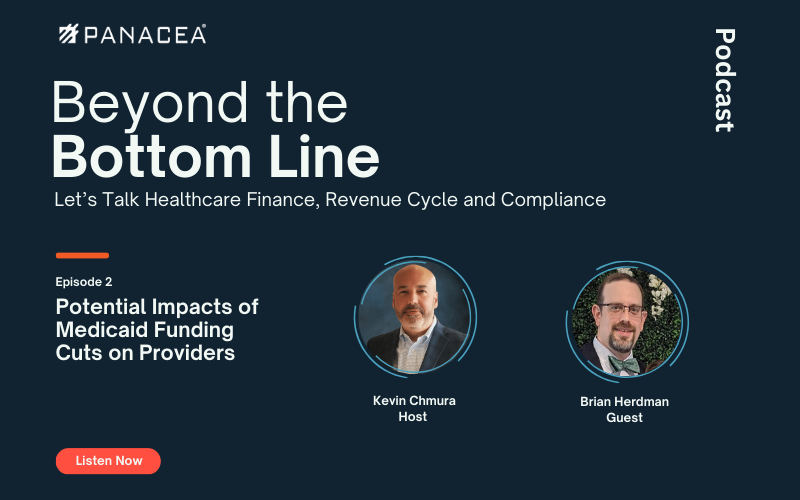
Potential Impacts of Medicaid Funding Cuts on Providers
With Host Kevin Chmura, CEO of Panacea Healthcare Solutions and Guest Brian Herdman, Director Financial Reimbursement Services
In this episode of Beyond the Bottom Line, Let’s Talk Healthcare Finance, Revenue Cycle and Compliance, host Kevin Chmura, CEO of Panacea, is joined by Brian Herdman, Panacea’s Director of Financial Reimbursement Services, as they discuss the House Republican budget plan’s mandate to reduce spending from a variety of programs, including Medicaid With cuts of approximately $880 billion in funding over the next ten years, find out what programs are likely to see a reduction.
Subscribe: Apple Podcasts | Spotify | Amazon Music | Android | Email | RSS
Episode transcript available below.
Kevin: Hi and welcome to this episode of Panacea’s new podcast Beyond the Bottom Line. I’m your host, Kevin Chmura, CEO of Panacea Healthcare Solutions.
In today’s episode, we’ll be discussing a very important and timely topic for every healthcare provider, particularly hospitals, and that’s Medicaid funding and potential changes proposed by the new Congress and endorsed by the administration.
We’ll also cover some practical steps you can take today that will help regardless of which of these proposals are adopted, or even if none of them are.
I’m joined today by Brian Herdman, Panacea’s Director of Financial Reimbursement Services. In addition to Brian’s day job at Panacea, helping hospitals maximize financial performance, he also leads our efforts to monitor the regulatory environment and position Panacea to best help our customers navigate those waters.
Brian, welcome to the show.
Brian: Thank you, Kevin. Glad to be here.
Kevin: Cool. So a lot going on in the world right now, a lot going on in healthcare.
There always is, but whenever there’s a changeover in administration and a new Congress coming in, there’s always a lot going on.
So particularly wanted to dive in today, the House Republican budget plan, which was endorsed by President Trump in February, includes cutting approximately $880 billion of funding over the next 10 years from a variety of programs. To put that into perspective, for anybody listening in 2023, which is the most recent full year data we have across the entire country, we spent 170, I’m sorry, $872 billion in Medicaid funding.
So in other words, we’re eliminating an entire year’s worth of funding over the next 10 years, or roughly 10%. But given the rise in health Medicaid spending since the onset of the ACA, the number’s actually much bigger than 10%, because we only reached 872 billion in 2023. It was much lower than that over the years prior to that.
So what I’m getting at, it’s a really big number. It’s a really big number that’s potentially coming out. There are some estimates for some extended proposals that take that number into the trillions, though perhaps, maybe unlikely.
So Brian? I know you. You immerse yourself in this as part of your part-time job with us. And so I know you’ve looked at this and you’re advising our customers through it.
What are some of the key things that you’re paying attention to in the proposals that are out there right now?
Brian: Hey, Kevin. So as I’m looking at this proposal, if you look at the actual legislative text you mentioned, there’s not really a whole lot to go off of, just a mandate to reduce spending.
So there’s no real specific policy behind it. So from there you have to look at what has been proposed in the past and what people are complaining about on the campaign trail and other things.
So when you look at these proposals, you know, one thing that bumps out right away is tweaking the dial on the federal match that the federal government pays out the states. This could be program specific. You know the Medicaid expansion population gets a much richer match from the feds, so that might be something that gets reduced down. Or there could be across the board decreases in that federal match.
One thing that comes up a lot is block grants. Possibly converting those Medicaid payments into per capita amount so that those are more inflation adjusted from the get-go. And they’re not really going to be determined by how the state spends that money.
And even there’s some other piles of money that the feds do matching on that could be eliminated there.
Nearly every state has some kind of provider tax that brings money into their state Medicaid program that is matched by federal dollars. Some of this is small and some of this is significant. In some states, it’s very significant, with hundreds of millions of dollars moved around and appropriated back to hospitals, nursing home, etc. With matching dollars from these programs, so any of them are ripe for reduction. And it could be a little bit of this could be a little bit of that, but there’s a lot for the Congress to choose from.
Kevin: Yeah, totally. And when you get into entitlement spending, it becomes highly politicized and very difficult to enact every proposal and it’s due to the nature of especially the Medicaid program, which is, you know, as we all know, administered by the states.
And so highlighting something you said, it you know anyone change will not have the same impact in every state it’ll be outsized depending on options that the states have chosen.
But I think it’s probably fair to say, and I’m sure you’d agree, that any reduction in funding is going to have an impact on, especially hospital financials. And you know, may be worse for some states, may be worse for some types of hospitals or where they rely on their funding.
So you know, so with the undoubted lead to this, it lead into financial hardship on providers. What are some of the things that you’re going to be kind of advising our customers to be looking out for in the next couple of years.
Brian: You know one thing in particular is if that Medicaid expansion cohort, if, if the matching funds really comes down on that, that side of the Ledger, states will have the opportunity to just discontinue that entirely. And in that case, we’re talking about entire cohorts of patients that just won’t be covered by their state Medicaid program. And some of the studies have put that number up to 20 million people.
If they start moving around with the match percentage or some of the other programs, then you’re starting to get into marginal impacts and it’s going to be state-to-state on how they handle their rates for hospital services or physician services and what kind of special programs they might do to support safety net hospitals.
If some of these match, some of this matching money goes away there is going to be a much smaller pot for the state to allocate in its rate setting process and as a result of that, it’s gonna depend on where that rate hit happens.
But safe to say that with the breadth of services the hospital provides, they’re gonna be feeling it in some way or another.
Kevin: Wow, so if I’m hearing you, you’re saying that what we could have is almost a triple effect of less people eligible for programs, a reduction in what the programs cover and then probably coinciding with all of that, a general reduction in reimbursement for those things that are still covered and for those people that are still covered. Is that right?
Brian: Oh yeah, that’s definitely the case. You know, if you take money away, it’s going to have to come in from somewhere else. Some states might be willing to bring in other general funds, but that’s going to affect other initiatives they might want to do in other areas, whether it’s, you know, supporting schools or other kind of property tax initiatives. So, there’s going to be a lot of tough, tough decisions around that.
Kevin: Very tough and tough this is a vulnerable population of people that that are covered by Medicaid and often being serviced by an equally vulnerable group of providers that do not live on healthy margins to fund all their programs. These are often rural or safety net that that hospitals that are that are heavily reliant on this funding so, so scary time.
So then let’s switch to perhaps something a little bit more practical.
We’re not trying to scare everybody, but there’s a lot happening there.
So if I’m a hospital administrator today, if I’m a Chief Financial Officer, revenue cycle VP. Any advice that you could give me on what I could be doing now to prepare?
Brian: Sure. Well, I mean, the main thing that I see is, you know, let’s look at your eligibility program and evaluate, you know, how strong and how much you’re really digging to make sure that your documentation and your relationships with patients are bringing in the right information you need to act and get them in the right program.
It may be the case that there’s some programs that have scant criteria to join, and those might be the first programs to go, so if you’re not, don’t have a shop that is really getting all that information in and you’re relying on, you know, an easy infra program, you might be in trouble and you might need to dig a little bit deeper and make sure you can find a more appropriate program for that patient that’s going to be continuing.
And you know, there’s always been this cost share concept in in healthcare with hospitals and whatnot. You know, trying to get more money from commercial payers to make up the difference so you know, let’s make sure that those commercial rates are doing as much lift as they can to make up that difference.
So it’s important to know that your maximizing your opportunity and all those other contracts to make sure you can get that money in for your margin for your mission.
Kevin: Oh, sorry, I didn’t mean to catch up. So it’s always been a necessity to pull in profits from other payers to cover Medicaid, but especially since the onset of the ACA, it has, there has been just an increased amount of people that are eligible and funding and it’s very easy for you to set up your hospital to rely on that source of income, and very tenuous with the opportunity to pull it away.
With the overall desire of the current administration to reduce government spending in every in every department, not just healthcare. So great, great advice.
So on the eligibility side, just maximize your opportunities, right? I think that’s probably the best way to say it.
Brian: Yeah.
Kevin: And then what I heard you say there and I like that because we do experience this in many of the states that we operate in, there have been lower documentation requirements for certain programs that are likely to go away.
And so perhaps flexibility in your eligibility program is going to be necessary? Really need to stay current on what’s happening federally. How that’s trickling down to your state, and how your state is enacting the changes that that are being imposed on them, and then translate that to the operations of your patient facing folks that are working with people inside your emergency rooms and all of your clinics and all of that.
So that’s a lot, Brian, but super helpful information. So, Brian, let’s wrap here. Let me let me just reserve the right to bring you back.
Brian: OK.
Happy to come back again.
Kevin: As the, as these things become enacted, right, these are proposals, now there this is a big budget proposal, now it will go through the meat grinder, it’ll get chopped up, but there will be something, I think we can all expect that.
So as we get closer and as we start to see final forms of these things I’d love to have you back so that we can take a deeper dive into the into the actuals if that’s good with you.
Brian: Sure. Let’s get it out.
Kevin: All right, great.
All right. So thanks for joining us, Brian, this is an important and timely topic.
For those of you listening, if you’d like to know more about our thought leadership at Panacea, or just Panacea in general, or learn more about Brian, please subscribe to Panacea Insights on our website or on LinkedIn.
Also, we will be conducting a webinar upcoming on April 16th on Medicaid topics like these with a deeper dive into some practical eligibility strategies, and so we would encourage you to join us for that. You can find information on that on Insights and on our website.
I’m Kevin Chmura, this has been Beyond the Bottom Line by Panacea. Stay tuned for upcoming episodes featuring more expert guests, and remember that when it comes to healthcare finance, every detail matters, staying current is important, so until next time, keep striving for excellence and driving innovation in healthcare. Thanks everybody.
